Educational Business Administration, M.Ed. program guide
A current program-to-course map for financial, operational, leadership, and evidence-based decision work, with the registered Canvas boundary preserved for every real assessment.
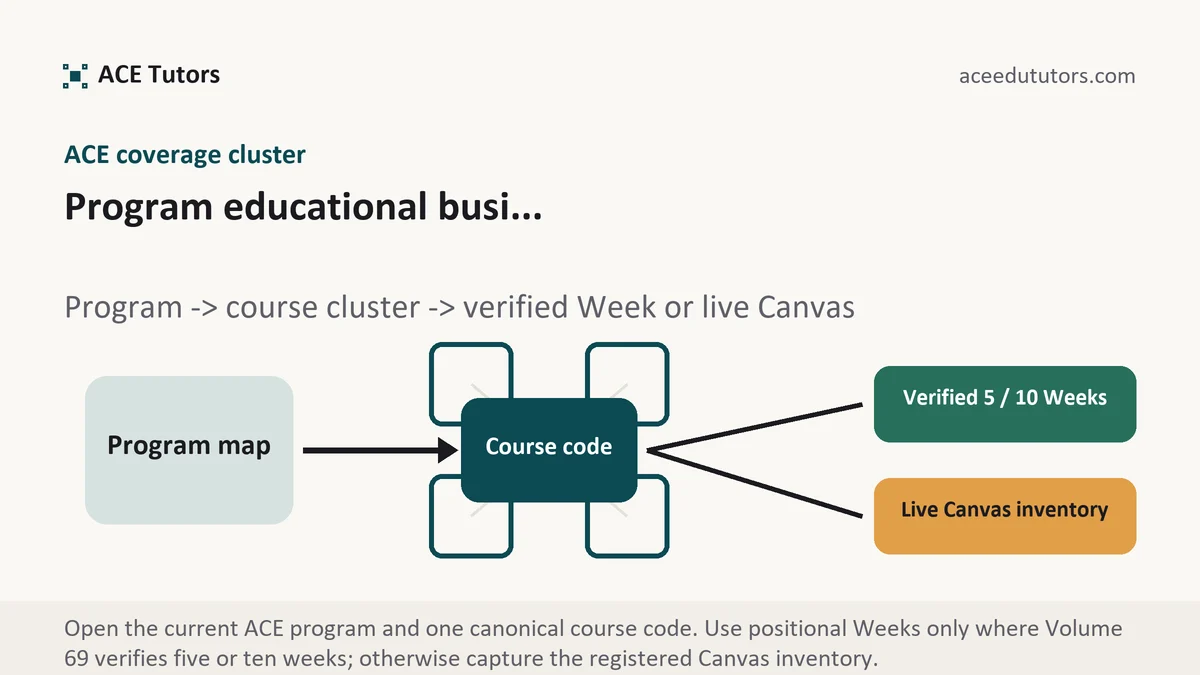
This graduate program is active in the July 13, 2026 ACE catalog. Its public page displays 23 distinct course codes under “Course List (31 Total Semester Credits).” Begin with the program map, open the exact course, then use positional Week guidance only where the catalog verifies a five- or ten-week format.
What the current program page establishes
The official record identifies the program, its catalog credit heading, and its displayed curriculum. Early subject anchors include Leadership Theories, Frameworks, and Philosophies, High-Performance Human Resource Management, Organizational Dynamics & Change Management. This page turns that evidence into navigation; it does not replace ACE admissions, state availability, a transfer evaluation, a degree audit, an advisor, or the registered classroom.
This catalog page displays required work together with focus-of-study, track, or elective choices. Appearance below does not mean every student takes every listed course. The registered degree audit and advisor-approved plan choose the applicable branch.
The classes, one by one
Open the canonical class page from the table. Shared codes have one page with backlinks to every mapped ACE program, so a research, leadership, or healthcare course is not duplicated with conflicting guidance.
| Course | Volume 69 title | Native next step |
|---|---|---|
| LEAD5653 | Leadership Theories, Frameworks, and Philosophies | Live Canvas assessment inventory |
| HRM5003 | High-Performance Human Resource Management | Live Canvas assessment inventory |
| ORG5003 | Organizational Dynamics & Change Management | Live Canvas assessment inventory |
| EBUS5203 | Financial Strategy for Educational Success | Live Canvas assessment inventory |
| EBUS5413 | Educational Facilities Management, Planning, & Operations | Live Canvas assessment inventory |
| EBUS5423 | Educational Data Analytics for Decision-Making | Live Canvas assessment inventory |
| EBUS5443 | Risk Assessment for Educational Organizations | Live Canvas assessment inventory |
| EBUS5091 | Capstone Experience for Educational Business Administration | Live Canvas assessment inventory |
| CSR5013 | Corporate Social Responsibility: Maximizing Resources | Live Canvas assessment inventory |
| FIN5013 | Strategic Financial Management | Live Canvas assessment inventory |
| SUST5063 | Developing Sustainable Business Strategies | Live Canvas assessment inventory |
| DIV5003 | Belonging and Inclusion in the Workplace | Live Canvas assessment inventory |
| DIV5013 | People-Centered Leadership | Live Canvas assessment inventory |
| DIV5023 | Recognizing and Reducing Favoritism | Live Canvas assessment inventory |
| DATA5003 | Data Analytics | Live Canvas assessment inventory |
| DATA5013 | Market Research | Live Canvas assessment inventory |
| DATA5023 | Strategic Management & Analytics | Live Canvas assessment inventory |
| HRM5463 | Employee Relations and Performance Management | Live Canvas assessment inventory |
| HRM5473 | Employment Law | Live Canvas assessment inventory |
| HRM5483 | Strategic HR Management | Live Canvas assessment inventory |
| SUST5003 | Building Better Businesses: Social Entrepreneurship in Action | Live Canvas assessment inventory |
| SUST5013 | People First: Creating Value Beyond Profit | Live Canvas assessment inventory |
| SUST5023 | Eco-Business: Strategy, Governance, and Sustainable Operations | Live Canvas assessment inventory |
The weeks and assessments, without guessing
Volume 69 verifies the course identities but does not publish one universal numbered assessment list or course-by-course Week count for this path. Each course therefore stops at the live Canvas assessment inventory instead of manufacturing Assessment 1, Assessment 2, or generic Week pages.
At the start of a registered course, capture the Canvas modules, syllabus, rubric links, announcements, group requirements, and exact due times into one control sheet. Reconcile that sheet after every announcement and grade. A term start date is useful for planning, but it is not evidence of an identical assessment sequence across 185 courses.
How to work the program as one system
Keep a program evidence bank instead of treating each course as a sealed box. Record the problem, population or organization, governing framework, strongest current sources, methods used, instructor feedback, and reusable student-created exhibits. Before a new deliverable, check whether earlier evidence remains current and relevant; then adapt it to the new purpose rather than recycling prose.
For business work, make the reasoning visible. Define the decision, identify the audience and constraints, separate evidence from assumption, choose the appropriate method, and connect every recommendation to a measurable consequence. This produces useful professional work and gives a rubric reader a traceable line from prompt to claim to evidence to conclusion.
Tutoring boundary and quality control
A sound support session begins with the student's actual prompt and rubric. The tutor can explain difficult concepts, demonstrate a parallel example, help find and evaluate sources, ask questions that expose missing reasoning, and give feedback on a student-authored draft. The student makes the substantive decisions, writes the final response in their own voice, verifies every citation and calculation, and submits through their own account.
Before submission, run four passes: content against the rubric, evidence against the cited source, technical work against the stated method, and presentation against ACE formatting and accessibility requirements. After feedback posts, classify each miss and write a prevention rule. That feedback loop is how one course improves the next.
Practicum, dissertation, capstone, and identity-controlled work
Any clinical, field, proctored, authenticated, or experiential requirement remains student-performed. Support can prepare the student and review de-identified work, never impersonate participation or certify hours.
Capstone support follows the same boundary: inventory the student's earlier work, identify the program outcome each artifact can evidence, close genuine gaps, and help the student assemble and explain the final product. The catalog itself shows that not every path has the same capstone shape, so this site never labels every program “capstone last.”
Source and change control
This map was checked against ACE Catalog Volume 69 on July 30, 2026. ACE published that volume on July 13, 2026 with the same effective date. If Canvas, an advisor, or a later catalog differs, follow the student's governing catalog and registered record. Report a changed code or title before using the map as a schedule.